embedded world Conference 2026
Three Conference Days Dedicated to Embedded Systems
The embedded world Conference is just around the corner and will once again cover all topics related to embedded computing this year. From 10 to 12 March, the current state of embedded technology and the latest trends from hardware to edge AI will be discussed in Nuremberg.
Hardware development, integration and testing are key aspects of embedded system design – and feature prominently in the programme of the embedded world Conference 2026 with the ‘Hardware Design’ track.
Embedded Hardware Design
From system architecture and electronics design to chip-level AI integration, twelve sessions, four classes and an expert panel impressively illustrate how modern electronics and SoC development is transforming under the influence of new architectures, growing system complexity and increasing security requirements. For hardware and FPGA developers, the programme offers a content-rich overview of highly scalable design methods, powerful semiconductor architectures and reliable components for safety-critical embedded systems.
Two sessions on certification, testability and integrity in the UCIe ecosystem, organised in collaboration with community partner UCIe Consortium, will demonstrate on the first day of the conference how chiplet-based designs are becoming a key trend in automotive HPC platforms. In addition, the RISC-V architecture plays a central role, as two sessions created in collaboration with the RISC-V Organisation on the third day of the conference will make clear.
In cooperation with the MIPI Alliance, a session was organised on innovations in the field of high-speed interfaces such as MIPI I3C and SoundWire I3S, and together with the FED trade association, the conference steering board organised another session dedicated to various aspects of the hardware design and production process.
Other topics include power and PCB design and open-source silicon. The programme also includes four in-depth classes on topics as diverse as designing a RISC-V FPU, protective measures against transient overvoltage, FPGA development based on C/C++, and the development of battery-free IoT nodes.
Edge AI
The megatrend of AI is also clearly noticeable in the world of embedded systems. The focus here is less on huge, resource-intensive large language models and more on artificial intelligence at the edge that is as compact as possible. So it's no surprise that the ‘Edge AI’ track stands out in the programme for the embedded world Conference 2026 with six sessions and three classes.
In the classes on the first day of the conference, participants will receive a comprehensive and in-depth introduction to tinyML and learn how to implement deep learning models on low-power microcontrollers. On Wednesday, 11 March, there will be a class in which participants will learn how to implement secure, AI-supported Linux devices.
The topics of the Edge AI conference sessions on the second and third days of the conference range from lightweight embedded AI, neuromorphic computing, qualification and validation to the execution of AI models, the transition from the lab to the field, and Edge AI use cases. The latter session was developed in cooperation with community partner Edge AI Foundation.
IoT and Connectivity
The Internet of Things (IoT) relies on reliable, secure and efficient connections and appropriate software architecture. The embedded world Conference takes this into account by combining the two topics of ‘IoT’ and ‘Connectivity’ in a joint track in 2026.
The continuous advancement of the IoT brings with it a combination of diverse requirements. These range from the security of both connectivity and data in motion to data and energy efficiency, especially in wireless applications, to mastering the extreme complexity of such coupled subsystems, known as dependable systems. Artificial intelligence is now also playing an increasingly important role, as evidenced by the ever-closer connection between the IoT and ‘edge intelligence’.
The embedded world Conference 2026 will address this broad topic in 12 sessions dealing with technologies of the IoT ecosystem, ambient IoT, long-range WiFi, CAN networks, Ethernet (including SPE), TSN, Bluetooth and the latest trends in cellular communication. Many of these sessions are the result of collaborations with community partners such as the Ambient IoT Alliance, CAN in Automation, SPE System Alliance and Bluetooth SIG.
Embedded OS
In the ‘Embedded OS’ track at the embedded world Conference, current technologies such as Zephyr and Yocto, as well as other (real-time) operating systems, will be discussed in depth alongside ‘classics’ such as Embedded Linux.
Together with the Yocto Project as a community partner, the two sessions ‘Long-Term Stability with Yocto’ and ‘Yocto Use Cases’ were developed, which are on the programme for the first day of the conference. In collaboration with the Zephyr Project as another community partner, the conference steering board has put together three sessions on the currently particularly interesting Zephyr OS, which will fill the track on embedded operating systems on the second day.
Other sessions will deal with topics such as containers, virtualisation and the orchestration of real-time operating systems. In addition, interested parties can take five intensive classes, including a half-day ‘Hands-on Zephyr Project Workshop’ and classes on topics such as firmware, embedded GNU/Linux in safety-critical applications and a full-day introduction to embedded Linux using a Yocto SDK.
Software and Systems Engineering
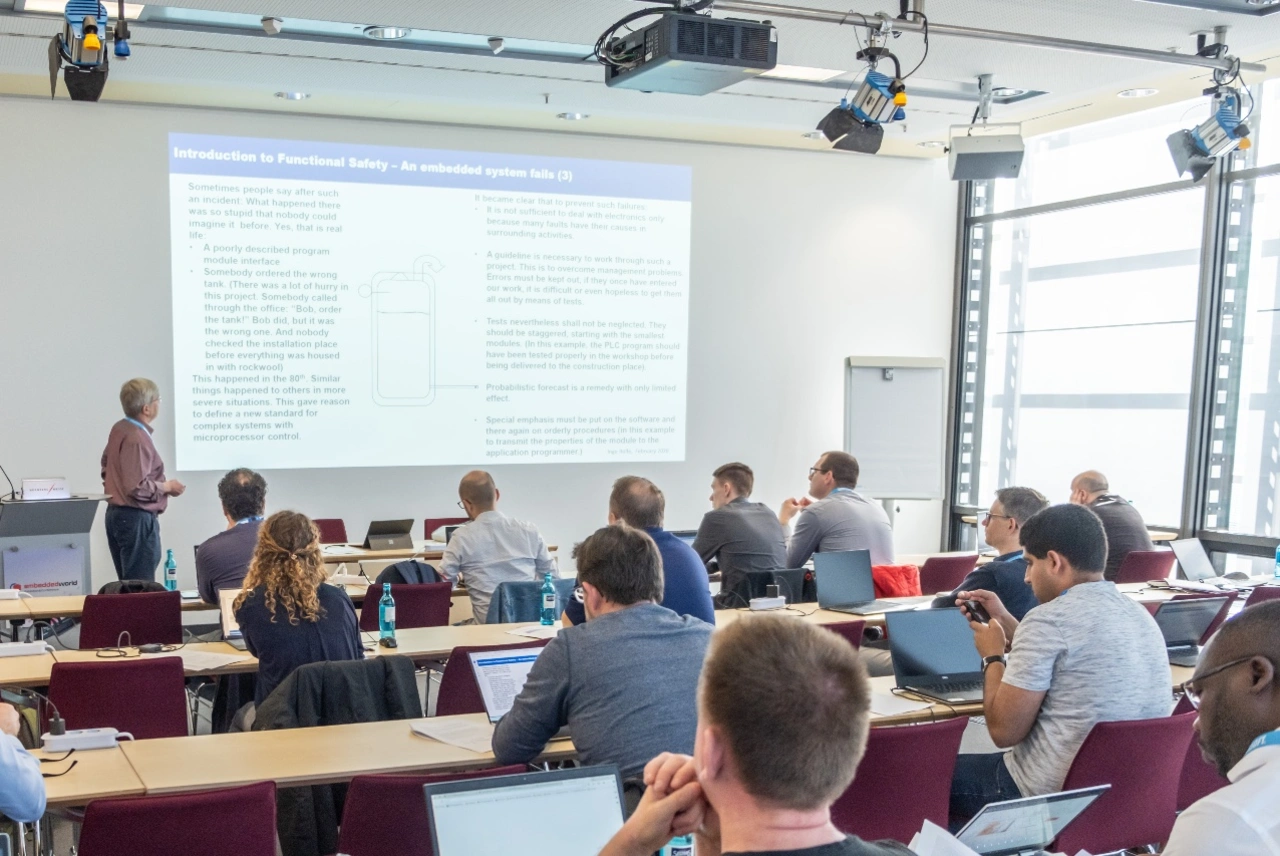
The Software & Systems Engineering track at the embedded world Conference 2026 will feature 15 sessions and five intensive classes demonstrating how modern embedded software development is becoming increasingly professionalised while also facing new technological challenges.
The focus will be on secure programming languages, with numerous presentations on Rust, modern C/C++ standards and safety-critical language concepts such as Fuzion. MISRA compliance (a session developed in collaboration with community partner MISRA) and robust coding standards also remain key topics for safety-critical systems.
Another focus of the programme is on software architectures for autonomous and software-defined systems – a session developed in collaboration with community partner Eclipse Foundation provides valuable insights here. In addition, the track from open-source middleware to functionally safe vehicle platforms shows how software-driven vehicle development requires new development models. This topic will also be addressed by the expert panel ‘Cybersecurity Strategies for Software-Defined Vehicles’ at the exhibitor forum in Hall 5 on Thursday, 12 March, at 11:30 a.m.
At the conference, further presentations on AI-driven code generation, digital twin approaches and automated MLOps processes for edge AI systems will illustrate how artificial intelligence is transforming not only runtime systems but also the development process itself. The programme is rounded off by sessions on DevOps, CI/CD, software quality, formal verification and legacy management – topics that are essential for sustainable product development. The track thus offers a comprehensive overview of modern software engineering methods that increase efficiency, quality and security in embedded systems in equal measure.
Safety and Security
As one of the key cross-cutting topics, the ‘Safety and Security’ track runs throughout all three days of the embedded world Conference – with a total of twelve sessions and three intensive half-day classes.
The topic of Cyber Resilience Act (CRA) continues to be a major focus, with one session and two classes devoted to it. CRA will also be present at the trade fair, not least in an expert panel on the topic on 11 March at 1:30 p.m. in Hall 3.
On the first day of the conference, two high-profile sessions will present the latest findings on ‘Open Source for Safety & Security’, while other sessions will showcase strategies for post-quantum cryptography and address the exciting question of whether and how AI can be trusted. The following day will focus entirely on reliability – from the examination of complex hardware solutions in the ‘Reliable Architectures’ session to RUST as a serious alternative to C/C++ to a complete session on the topic of efficient testing of reliable products, in which both static and dynamic methods will be considered – and one class will be devoted intensively to the topic of ‘Embedded Safety Architectures’.
Thursday will once again focus on cryptographic hardware and software solutions for long-life embedded devices, as well as the ‘DevSecOps’ session, in which current automation trends for the development process in regulatory projects will be discussed. Finally, the session ‘Trustworthy Systems with CHERI & RISC-V’, a collaboration with the CHERI Alliance as a community partner, will show what RISC-V, and in particular the CHERI memory concept, has to offer for safety and security architectures.
Embedded Vision
Embedded vision is one of the key topics on the embedded world Conference programme, with six sessions and an expert panel. This is hardly surprising, as this application pushes many of the embedded components used, such as image sensors, capture and processing technology, and high-speed interfaces, to their limits.
The integration of sensor technology and systems demands the full expertise of embedded vision developers, and edge AI is becoming increasingly important for evaluating image data as close as possible to the sensor and making decisions based on the results.
In the session on ‘Embedded Vision Use Cases’, which will be on the programme for the first time in 2026, the various technical aspects will be discussed in a specific application context. Related imaging techniques such as lidar and radar will also be the subject of a separate session for the first time this year.
Also on the agenda: On the first day of the conference, the sessions ‘Embedded Vision Concepts & Standards,’ ‘Hardware Acceleration’ and ‘Embedded Vision Pipelines,’ which was launched in collaboration with the Edge AI and Vision Alliance as a community partner of the embedded world Conference – and on day 2, the session ‘Emerging Embedded Vision & Audio Technologies.’ On the third day of the conference, starting at 1:30 p.m., five participants in an expert panel entitled ‘Embedded Vision on the Rise’ will discuss how new hardware designs and physical AI are pushing the boundaries of embedded image processing in the exhibitor forum in Hall 3 of the embedded world trade fair.
Use Cases for Embedded
New to this year's embedded world Conference programme is a dedicated track entitled ‘Use Cases for Embedded’. In a total of six sessions on the second and third days of the conference, speakers will highlight specific use cases from the fields of medicine, predictive maintenance, mobility, security and development processes.
The entire programme for the embedded world Conference 2026, including all presentations and classes with abstracts, information about the speakers and an online registration option, is available online at www.embedded-world.eu.