In-Ear-Measuring of the Heartbeat

ams Osram: Tiny LED Chip for Precise Vital Data on Wearables

15. April 2025, 10:20 Uhr | Elektronik Medical (uh)
ams osram wearables vitaldaten messung PPG LED Chip integration Medtech-Entwicklung
© ams Osram

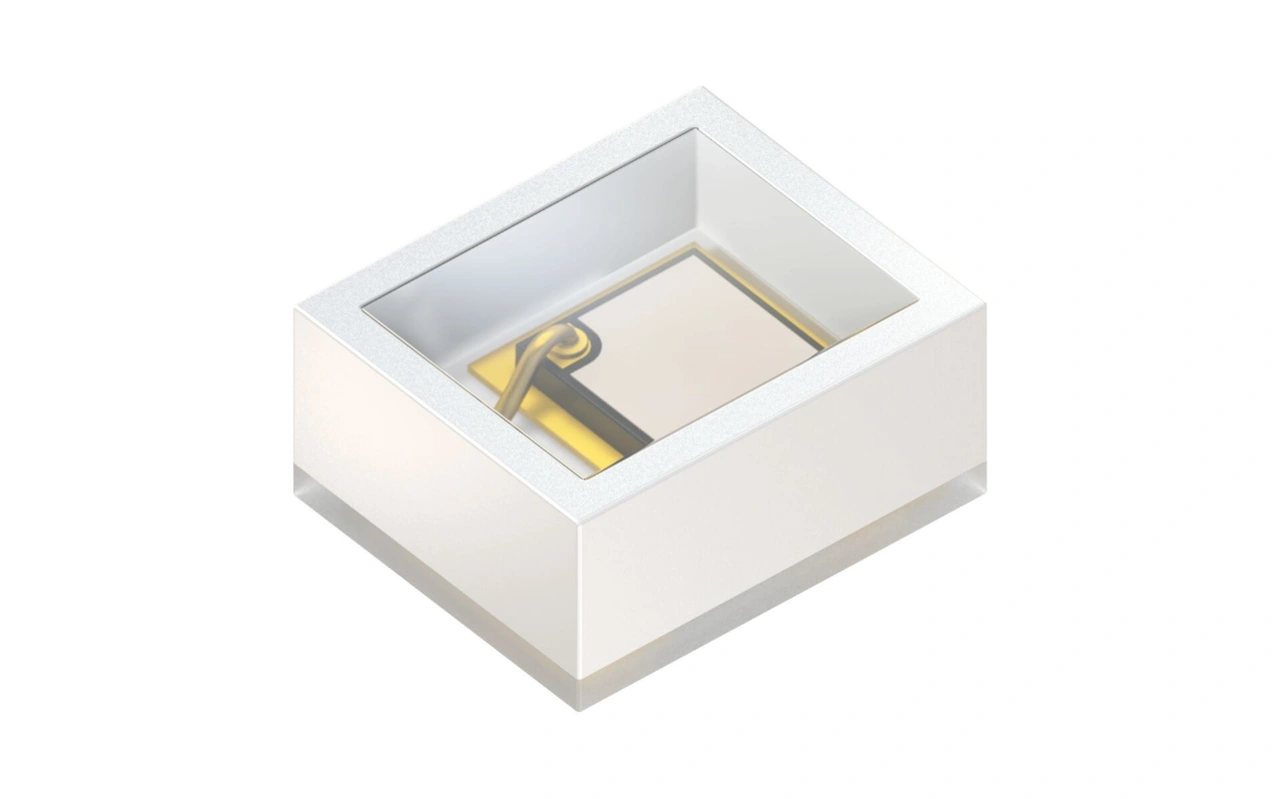
Whether headphones or smart rings: a new chip LED from ams Osram now detects the heart rate in wearable devices even more precisely using PPG measurement. With a high light output, the 500µm chip can be easily integrated to increase signal quality - it is barely larger than a grain of sand.

The sensor and semiconductor manufacturer ams Osram has presented a new miniaturized chip LED for the precise measurement of heart rate in wearable devices. For developers of wearables such as in-ear headphones or smart rings, the powerful 500µm chip can help to improve signal quality: at just 1.2 mm x 1.0 mm x 0.6 mm, the LED is barely larger than a grain of sand - and yet delivers a remarkable light output of 14mW.

More Light for More Precise Blood Volume Measurement

The CT ELLN51.14 chip LED has a 20 percent increase in brightness compared to its predecessor model and enables more efficient photoplethysmography (PPG) with even more compact dimensions.

The standard measurement method recognized for wearables measures changes in blood volume in the vessels by sending green light into the skin and evaluating the reflected signals. A more powerful light source, such as the new chip LED from ams OSRAM, significantly improves the measurement accuracy, especially in smart devices such as headphones or rings that are worn on areas of the body with good blood circulation.

At the same time, developers can also use the higher efficiency to reduce the energy consumption of their wearables and thus extend the battery life - a decisive factor in the purchase decision for devices that customers usually use for several years.

Wearable development for medicine:

»Vital signs are difficult to measure on the wrist«

Our exclusive interview with Florian Lex from ams Osram (in German)
ams Osram Grüne Emitter Wearables PPG Vitalzeichen Monitoring
Barely bigger than a grain of sand: the new chip LED from ams OSRAM increases its brightness by around 20 percent compared to its predecessor model, with even more compact dimensions of 1.2 x 1.0 x 0.6 millimeters.
© ams Osram

Precise Vital Sign Measurement in Smallest Spaces

»We have proven our expertise in monitoring vital signs and are following the trend towards miniaturization with high-performance products,« says Florian Lex, Product Marketing Manager at ams OSRAM. »Our new chip LED supports even more reliable heart rate measurement - even in devices that need to be unobtrusive yet precise.«

Continuous monitoring of vital parameters is becoming increasingly important - both in the medical and fitness sectors. As fingers and earlobes have better blood flow than the wrist, components placed there provide particularly precise data. The new green CT ELLN51.14 single emitter now makes these measurements possible in extremely compact designs and, according to Lex, promotes the trend towards powerful, unobtrusive wearables. In addition to LEDs, ams OSRAM offers numerous components for vital sign monitoring - including proximity sensors in headphones that can detect when the device is in the ear and thus support energy-saving functions.

1500 Patents for Green Emitters Alone

In the highly competitive wearable market, in which manufacturers and suppliers from Asia also play a major role, the Austrian-German sensor manufacturer can point to its long track record in the development of compact, high-performance LEDs. In the field of green emitters alone, which are important for PPG measurement, ams Osram holds more than 1500 patent rights as well as other IP rights to protect its developments. A further 200 patent rights in vital sign monitoring underline the proprietary technology expertise. (uh)

Anbieter zum Thema

zu Matchmaker+

Lesen Sie mehr zum Thema


Das könnte Sie auch interessieren

Medizintechnik Siemens Healthineers Abspaltung Beteiligung Verkauf Digital Industries

The End of an Era

It's Decided: Siemens is Spinning off Healthineers

Radiologe, der auf einen Bildschirm sieht, der zwei MRT-Aufnahmen des weiblichen Brustgewebes zeigt.

Early Detection of Breast Cancer

Team of AI Agents for Improved Mammography Screening

Samsung Xealth Medizintechnik Gesundheitsdaten Versorgung Wearables Klinik

Digital Health | Connected Medicine

Samsung buys Xealth: Wearable Data into Clinical Care

MedtecLIVE Messe Innovation Expo Bayern Innovativ Healthtech Pavillon Automatica

Applications From the Munich Show Floor

The Medical Technology Highlights of Automatica 2025

Medizintechnik Infineon Lab on Chip System on Chip Diagnose Handy

Lab@Home from Infineon

Single-Chip System for Smartphone Diagnosis

Medizintechnik Componeers SDC Protokoll KOnnektivität Standard Operationssaal OP Medizinegräte Verbindung Vernetzung

Interoperability in the OR

GE Healthcare Joins OR.Net and Strengthens Connectivity via SDC

Medizintechnik Componeers SDC Protokoll KOnnektivität Standard Operationssaal OP Medizinegräte Verbindung Vernetzung

Interoperabilität im OP-Saal

GE Healthcare tritt OR.Net bei und stärkt Konnektivität über SDC

Konnektivität RTI Nvidia connext holoscan SDK medical medizintechnik medizinrobotik OP-Technik

In Echtzeit ohne Single Point of Failure

DDS-Standard: Datenbus für schlaue Medizingeräte

Sensodrive Medizinrobotik Antriebe Medizintechnik Komplettantriebe TÜV Safety Sicherheitszertifizierung

For Industry and Medicine

The First Torque-Controlled Robot Drives with Full Safety

Medizinelektronik Chip-Design Security Halbleiter Architektur Medizintechnik Sicherheit Connectivity

Neue Architektur für Halbleiter-Designs

On-Chip-Sicherheit für die Medizin

Sensodrive Medizinrobotik Antriebe Medizintechnik Komplettantriebe TÜV Safety Sicherheitszertifizierung

»Sensojoint Safe« für die Medizinrobotik

Die ersten drehmomentgeregelten Roboterantriebe mit voller Safety

EDAG Entwicklungsdienstleister Medtech Digital Health Componeers Elektronik Medical Medizintechnik Entwicklung Software Komponenten Hardware Embedded World Nürnberg

Kurz-Interview // EDAG Engineering

Welche Medtech-Komponenten haben Sie auf der #ew25 begeistert?

Medizinische Bildgebung ams Osram Design Center Valencia Entwicklung Medizintechnik CT Röntgen Sensoren Photon Counting Detektoren Greger

Exklusiv-Interview // ams Osram

»Wir brauchen KI, um das Photon-Counting-Potenzial auszuschöpfen«

Medizintechnik Alzheimer Forschung Gehirn 3D Karte Google Earth

Navigating like in Google Earth

Against Alzheimer's: AI Creates 3D Map of the Brain

Medizintechnik EMPA Muskelgewebe Aktuator Robotik 3D-Druck

Biomechanics for Medicine

Heart Print: Artificial Muscles made in a 3D Printer

KI chatbot Klinik Krankenhaus Medizintechnik AI Diagnose Notaufnahme

Ambient Computing for Hospitals

Microsoft Dragon Copilot: AI Assistant to Relieve Clinics

Medizinische Bildgebung ams Osram Design Center Valencia Entwicklung Medizintechnik CT Röntgen Sensoren

System-in-Package from ams Osram

Photon Counting: New CT Sensor Module for Future Medical Imaging