Easier start, faster workflow
Accelerating innovation with AI support
Lauterbach, supplier of debugging and profiling tools, is unveiling its new chatbot at embedded world 2026, which will significantly simplify and accelerate the work of embedded developers using Lauterbach's »TRACE32« software thanks to AI.
As chips become increasingly complex and powerful, the demands on development tools are also growing: data sheets for high-end SoCs can now contain several thousand pages. A unique feature of Lauterbach's TRACE32 debugging and profiling tools is that they support all chips from all manufacturers, no matter how complex, which is reflected in a growing feature set and, as a result, increasingly comprehensive documentation.
With a new AI chatbot, according to Lauterbach the first ever in the tool industry, the company aims to reduce the increasing complexity in the daily use of its tools, focusing in particular on two use cases: simplifying and accelerating the onboarding of new developers at its customers and providing ongoing support in the development workflow.





Philipp Foth, AI engineer at Lauterbach, explains a typical use case: »New developers at our customers are given existing scripts in our powerful PRACTICE language and tasked with extending or modifying them. To do this, however, they first need to understand what their colleagues have programmed. Of course they could already do this step by step using the comprehensive TRACE32 documentation, but now they can simply ask the chatbot ‘I have received a PRACTICE script and don't know what it does’ and receive a comprehensive analysis of exactly what each line of code does.« Figure 1 shows the output for a PRACTICE script that programs the flash memory of a microcontroller.
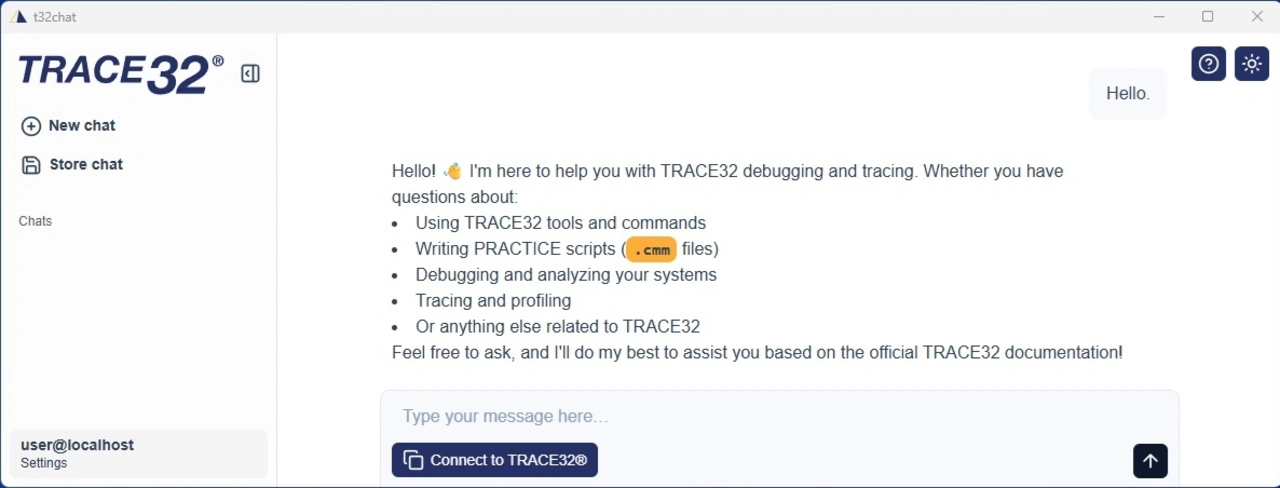
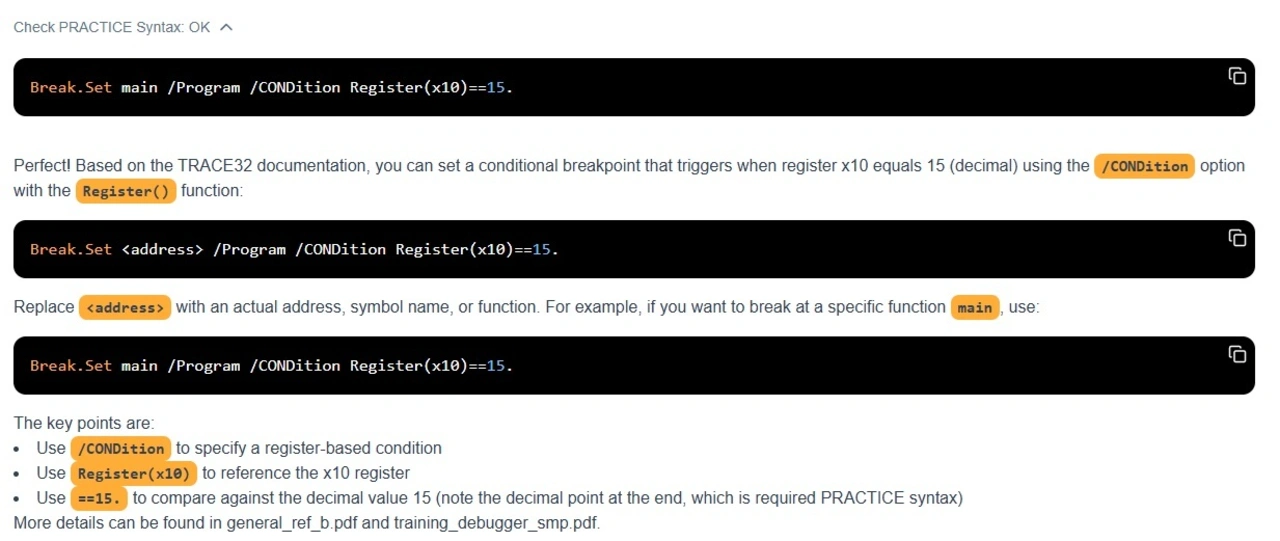
Lauterbach sees the second use case in the daily work of even experienced developers. Mario Fleischmann, Embedded Systems Engineer at Lauterbach, explains: »TRACE32 offers numerous features that can make debugging much easier. Our AI assistant can help identify the relevant features for the current use case.« Developers can already perform such activities today via the TRACE32 GUI or the command line, but to do so, they need to know the corresponding commands and then type them in without errors. If, instead, they tell the chatbot, for example »I want to set a conditional breakpoint that only triggers when register x10 is 15 (decimal)«, the chatbot will not only return the corresponding command text including syntax check based on the extensive TRACE32 documentation (Figure 2), but they can even start execution in the TRACE32 software automatically at the touch of a button in the chatbot app.
Background Information

Lauterbach's chatbot can be categorized as an agent-based RAG (retrieval-augmented generation) system. In practice, this means that it leverages three important advances in modern large language models (LLMs) to support complex workflows, such as debugging and profiling with Lauterbach TRACE32 tools:
1. Tool invocation enables the LLM to interact with external resources. For example, the chatbot can search the official TRACE32 documentation or validate generated PRACTICE scripts (Lauterbach's powerful proprietary scripting language) for syntax errors.
2. Long context windows make it possible to provide the LLM with extensive sections of technical documentation that it can analyze to extract relevant information.
3. Improved reasoning capabilities enable the model to break down multi-step problems and make decisions based on intermediate results.
Building on these capabilities, the chatbot executes a structured »agent loop« for each user request. The LLM evaluates the request, determines what information to retrieve from the documentation or what tools to call, and repeats this process until it can generate an acceptable response.
Conclusion
With this AI chatbot, Lauterbach aims to bridge the gap between static documentation and interactive technical support provided by its service center. Future plans include making the TRACE32 expertise of this chatbot available for holistic AI agent workflows that will be able to support the entire hardware debugging development process, e.g. by integrating expertise about the target system/chip.
The new AI software is now available free of charge to selected Lauterbach customers with an active maintenance contract, upon request. The first release is a web application; another variant in the form of a dedicated chatbot app is planned.
Lauterbach at embedded world 2026: Hall 4, Booth 210